Guest Blog by Keith Berelowitz- CEO pRxEngage AML and ALL: understanding the bigger picture, and why looking beyond standard treatment matters
16 April 2026

Hearing the words acute myeloid leukaemia, or AML, and acute lymphoblastic leukaemia,
or ALL, can be frightening. For most people, it is not just the diagnosis itself. It is the
speed of it all. New words, new tests, the need to make urgent decisions. A lot of fear,
and often not nearly enough of this is provided in plain language.
AML and ALL are both acute blood cancers, which means they usually develop quickly
and need fast specialist care. AML is more common in adults, especially older adults. ALL
is seen more often in children, although adults can develop it too. On a global level,
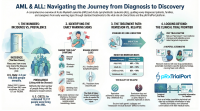
studies based on 2021 burden data estimate roughly 144,645 new AML cases worldwide
in that year, while the global age-standardised incidence rate for ALL was estimated at
1.37 per 100,000 people, (1,2).
It is worth pausing on two words that often come up in discussions like this: incidence
and prevalence.
Incidence means the number of new cases diagnosed over a set period of time, usually
each year. So when we talk about incidence, we are talking about how many people are
newly told they have AML or ALL. Prevalence is different. That means how many people
are living with the disease at a given point in time, whether they were diagnosed
recently or years ago. In simple terms, incidence tells you how many new doors this
disease knocks on each year. Prevalence tells you how many people are living with its
impact overall. In the United States, for example, the rate of new AML cases is 4.3 per
100,000 people per year, and an estimated 79,317 people were living with AML in 2022
(3,4).
AML and ALL are not tiny, obscure conditions affecting only a handful of families. They
are serious diseases with a real global footprint, yet, to most people, they are still poorly
understood until they arrive uninvited into their own lives.
One of the reasons these diseases can be so difficult is that the early signs may not look
dramatic at first. People may feel unusually tired, become short of breath, bruise more
easily, get frequent infections, develop fevers, notice bleeding from the gums, nose
or feel generally unwell.
In ALL, some people may also have swollen glands or bone pain.
These symptoms do not automatically mean leukemia, of course, but when they persist
or start to build up together, they need proper medical attention.
Once diagnosed, treatment usually starts quickly. This is where people often hear the
phrase standard of care. That simply means the treatment doctors currently use as the
accepted starting point, based on the best available evidence today. In adult AML,
remission rates vary by age, but for many younger adults remission is achieved in well
over 65 percent of cases after induction treatment. Induction treatment is the first
phase of treatment given soon after diagnosis to try to bring the leukemia under control
as quickly as possible. Its aim is to push the disease into remission, which means
reducing the leukemia cells to a very low level so the bone marrow can start making
healthy blood cells again.
It is worth noting that in adult ALL, around 60 to 80 percent of adults usually achieve
complete remission after initial induction therapy (5,6).
Getting into remission is hugely important, but remission does not always mean the
disease is gone for good. Some people do not respond as hoped to first treatment.
Others respond well and then relapse later. This is one reason doctors pay such close
attention to the exact subtype of leukemia, the genetic findings, and how deeply the
disease has responded to treatment. AML and ALL are not single diseases with one fixed
story. They are broad groups of disease, and what happens next can vary a great deal
from one person to another.
That is exactly why it helps to look beyond standard treatment alone.
This does not mean standard treatment is not important, it absolutely is. However
patients and families should know there may be more to discuss. The very encouraging
thing for patients and families is that research is constantly evolving. New targeted
drugs are being developed, new combinations are being tested. And better ways of
identifying who may benefit from which treatment are being studied all the time.
This is really important for patients of today and tomorrow. We must accept though
that the phrase clinical trial can sound intimidating when people first hear it. It can
make families think of risk, uncertainty, or being experimented on. In reality, clinical
trials are how medicine improves. They are how doctors learn whether a newer therapyworks better, works more precisely, or causes fewer side effects than what came
before. They are also one of the ways some patients may gain access to the latest
treatments earlier than they otherwise would.
While research can sound scary from the outside, it can also represent something
genuinely hopeful. It can mean access to cutting-edge therapies. It can mean another
option if the first one does not work as hoped. It can mean a treatment approach that is
more closely matched to the biology of the disease. For some families, it can mean a
sense that every sensible avenue is being explored, not just the obvious one.
The problem, of course, is that finding and understanding this information is not easy.
When someone is dealing with the shock of an AML or ALL diagnosis, asking them to
trawl through technical trial listings and complicated eligibility criteria is a bit ridiculous.
It is hard enough getting through the day without trying to decode a small forest of
acronyms.
That is where clearer tools can help. A platform like pRxTrialPort can give patients,
families, and caregivers a more accessible starting point for exploring what research
may be available in AML or ALL. It is not a replacement for a hematology team, and it is
not a substitute for medical advice, yet it can help people understand what may be out
there, feel more informed, and have better conversations with the clinicians caring for
them.
When someone is facing AML or ALL, they need more than jargon and more than a
rushed explanation. They need clarity, support, and a clear sense of what options may
exist now, what could come next, and where research might open another door.
In a situation like this, people should not be left wondering whether anyone
remembered to look beyond the obvious. They deserve to know that every reasonable
path is on the table.